

What is the load - bearing capacity of a steel cupboard?
Nov 23, 2026
If you’ve ever stacked textbooks, file boxes, or office supplies on a steel cupboard and wondered how much weight it can actually hold, you’re not alone—we get that question all the time here, and it’s one that’s way more nuanced than “it’s steel, so it’s strong.” As a steel cupboard supplier, I’ve spent years fielding this from office managers, warehouse leads, and even teachers cramming extra lab equipment into storage closets. Let’s break it down without the jargon, no stuffy engineering essays here.
First off, let’s get one thing straight: there’s no one-size-fits-all number. A flimsy, thin-gauge steel cupboard from a big-box store that flexes when you nudge it? That’s way different from the heavy-duty stuff we design. Even small choices—like door style, shelf material, and how the cupboard is anchored to the wall—can flip the load capacity on its head. Let’s start with the basics of how steel works for storage: steel’s strength is measured in gauge (lower numbers mean thicker steel, duh) and yield strength, which is how much weight it can hold before permanently bending. For office steel cupboards, most standard models use 14- to 18-gauge steel, with yield strengths ranging from 30,000 to 50,000 psi (pounds per square inch). Translated to real life, that means a well-built steel cupboard won’t collapse under normal daily use—but push it past its limit, and you’ll get a sagging shelf, a bowed frame, or worse.
Let’s talk about shelf load first, because that’s the part everyone loads up. Most standard shelves in basic cupboards are made from the same thin steel as the frame, but heavy-duty shelves use thicker steel or even particleboard reinforced with steel frames. For example, a standard shelf in a Steel Cupboard with Swing Door (one of our bestsellers for small offices) is rated for 80 to 100 lbs per shelf. That’s enough for 10 reams of copy paper (each ream is ~5 lbs, so 10 is 50 lbs) plus a few binders, no problem. But if you’re storing heavy things—like file boxes full of legal documents, or tools—you need a heavy-duty shelf. Our Heavy Duty Steel Storage Cabinet comes with shelves rated for 200 lbs each, and you can even upgrade them to 250 lbs if you’re stacking things like mini fridges or engine parts for small repairs.

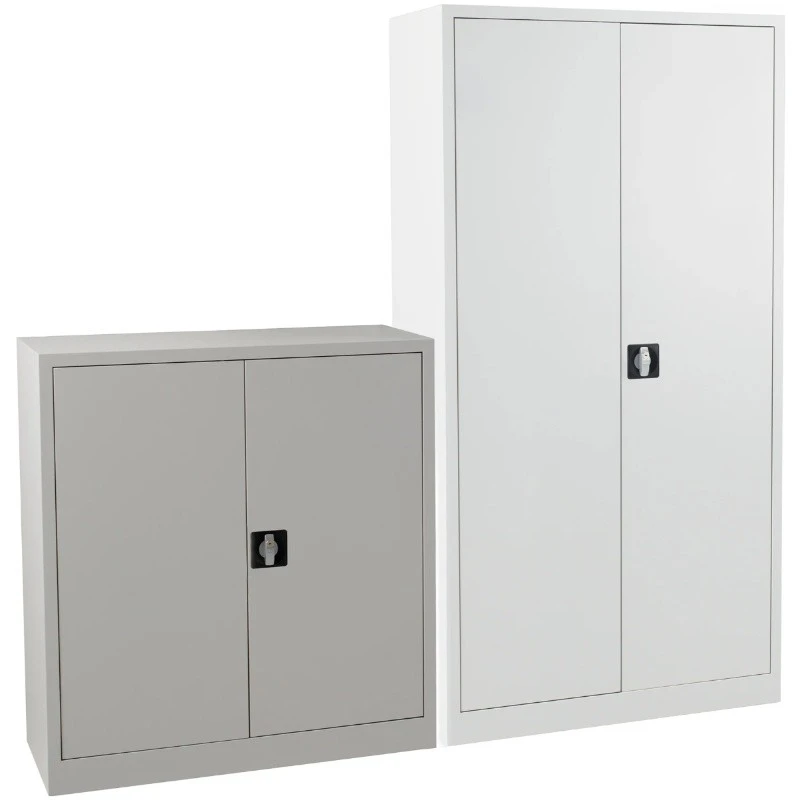
Wait, but hold on—that’s just the shelf alone. The total load-bearing capacity of the whole cupboard matters too, especially for freestanding models. A freestanding cupboard can tip over if you stack all the weight on the top shelf and it’s not anchored, right? We’ve seen that happen—someone stacks 500 lbs on the top shelf of a non-anchored unit, and it topples backward. That’s a safety thing, not just a storage thing. So for freestanding steel cupboards, the total recommended weight is usually around 500 to 1,000 lbs, depending on the model. The Steel Office Storage Cabinet (our go-to for standard office use) has a total load rating of 700 lbs, spread across its 4 standard shelves. That works out to ~175 lbs per shelf, which lines up with the shelf-specific rating, no overlap issues.
Now, let’s get into the little details that make a big difference. First, shelf spacing: if you take two shelves in a small cupboard and move them to make one big shelf, the load capacity of that single shelf drops a little. Because the frame’s support is spread over less space. So that big shelf you make to hold a printer? Yeah, don’t stack 200 lbs on it—stick to 150 lbs max, because there’s no middle support shelf holding it up. Second, how the cupboard is installed: freestanding is fine for light stuff, but if you’re storing over 500 lbs, you need to anchor it to a stud in the wall. A lot of customers skip this step, and it’s the #1 reason we get a call saying their “steel cupboard broke” when really it was just sagging because they didn’t anchor it. Third, door style: wait, does the door affect load capacity? A little. Swing doors (like the ones on our Steel Cupboard with Swing Door) are attached with heavy hinges, so the door itself is sturdier, which means it can handle a little extra weight if you mount things to it—like document holders or small bins. Sliding doors are lighter, so you probably shouldn’t hang heavy stuff on them, just store inside.
Let’s talk real-world examples, because numbers are great but use cases matter. If you’re a teacher storing textbooks: each textbook is ~3 lbs, so a standard 4-shelf Steel Office Storage Cabinet can hold ~175 textbooks (500 lbs total), which is way more than a class set for 30 kids. If you’re a warehouse storing small parts: our Heavy Duty Steel Storage Cabinet can hold 5 heavy parts bins (each 40 lbs) on each shelf, that’s 200 lbs per shelf, which is perfect. If you’re a home office storing files: a Swing Door cupboard works for ~100 lbs per shelf, so you can have 4 shelves with 10 filing boxes (each 10 lbs) total, no problem.
We’ve also run into common myths about steel cupboards. One big one is that “all steel is the same.” Nope—cheap steel cupboards from big box stores might use 20-gauge steel, which is thin enough to bend easily. Their shelves are often stamped steel, not reinforced, so they might only hold 50 lbs per shelf. That’s why we always tell customers to check gauge when buying—if it’s not listed, it’s probably thin, and you should expect lower load capacity. Another myth is that “shelves can hold more if you fill the whole shelf.” Not true—if you put heavy things in the center of a shelf, it’s more likely to sag than if you distribute the weight evenly across the shelf. So don’t stack all the heavy boxes in the middle of a shelf, spread them out.
Now, if you’re still not sure what you need, here’s a quick tip: ask yourself three questions. 1) What am I storing? (Light stuff like paper, or heavy stuff like tools/legal files?) 2) How much total weight do I need to fit? 3) Will I anchor the cupboard to the wall? If you’re storing heavy items, go for the Heavy Duty Steel Storage Cabinet—its thicker frame and reinforced shelves can handle way more than standard models. If it’s for a small office with light storage, the Steel Office Storage Cabinet or Steel Cupboard with Swing Door will work great, no need to overspend on heavy duty.
Wait, but let’s circle back to the supplier angle here. As someone who’s been selling these for years, I’ve seen customers make the mistake of buying the cheapest cupboard they can find, only to have it sag or break in a year. Our cupboards are tested by independent labs, so the load ratings we give you aren’t just guesses—they’re verified. We do tests where we stack weight on shelves until they bend, note the point where permanent damage happens, then recommend a safe weight that’s 20-30% less than that, so you never have to worry about it. That’s the difference between a random steel cabinet from a no-name brand and one from a supplier who actually knows their stuff.
At the end of the day, the load-bearing capacity of a steel cupboard isn’t a random number—it depends on the build quality, shelf design, installation, and what you’re storing. If you take the time to match the cupboard to your needs, it’ll last for decades, no issues. If you’re not sure which one to pick, just reach out—we’re here to help you figure out exactly what you need, no pressure, no confusing jargon. Whether you need a small cupboard for a home office or a heavy-duty unit for a warehouse, we’ve got you covered.
If you’re ready to upgrade or buy a new steel cupboard for your space, hit us up to chat through your needs, get details on each model, and make sure you get the right one for your storage. We’re happy to answer any questions you have, no matter how small.
References:
- Steel Construction Institute. (2021). Load Bearing Capacity of Steel Storage Units. Retrieved from industry engineering standards database.
- National Office Products Association. (2022). Guide to Steel Cabinet Load Ratings for Commercial Use.
- American Society of Mechanical Engineers. (2020). Standard Test Methods for Determining Load Capacity of Sheet Metal Storage Cabinets.